Oil Rises as Iran-Oman Hormuz Deal Nears but Reopening Remains Uncertain
Key Market Data (August 10, 2026)
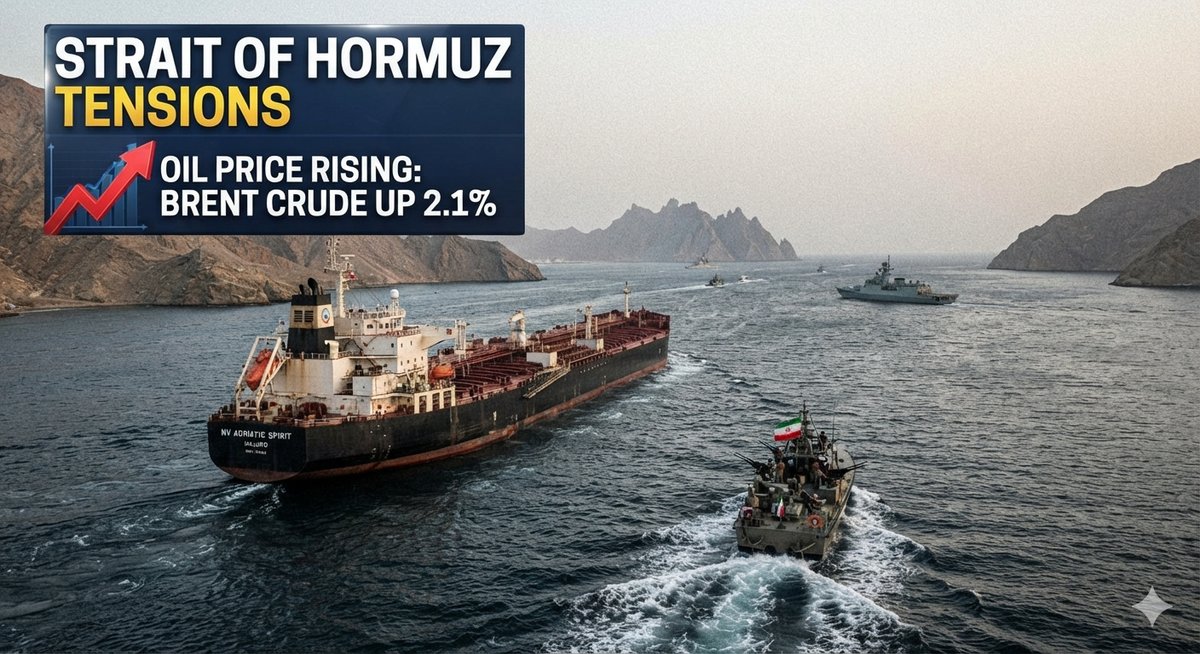
Oil prices edged higher on Monday as uncertainty persisted over the reopening of the Strait of Hormuz, with Iran saying a deal with Oman defining new shipping lanes was in its final stages but insisting the United States must still meet additional conditions before the strategically vital waterway could fully resume operations.
Brent crude futures rose 91 cents, or 1.09%, to $84.46 a barrel by 0056 GMT, while U.S. West Texas Intermediate crude futures gained 61 cents, or 0.78%, to $78.79 a barrel. The modest recovery came after both benchmarks had fallen more than 7% last week on hopes that Iran and Oman were close to reaching a deal that would lead to the reopening of the Strait of Hormuz, which carried a fifth of the world's crude oil before the war.
The Diplomatic Standoff: What Iran Actually Said
Iran's messaging over the weekend was carefully calibrated to project progress while preserving leverage. On Sunday, Iranian Foreign Minister Abbas Araghchi confirmed that a deal with Oman defining new shipping lanes through the Strait of Hormuz was in its "final stages." However, Tehran simultaneously reiterated that the waterway would only reopen once Washington met several conditions, including compensation for widespread U.S. attacks on Iranian territory.
"Iran and the U.S. are not engaged in talks and Tehran will not start them as long as Washington breaches an interim deal signed in June." Abbas Araghchi, Iranian Foreign Minister
The distinction between "exchanging messages" through intermediaries and actual negotiations is critical. Araghchi explicitly rejected Trump's characterization of the diplomatic process, stating that Iran was merely exchanging messages via intermediaries while Washington insisted any reopening must ensure unrestricted navigation without Iranian tolls or conditions.
Iran's Revolutionary Guards went further, declaring on Sunday that the strait remains a "theatre of war" until the United States ends its "war and aggression against Iran and its allies in Lebanon, Palestine, Yemen and Iraq." This language suggests Tehran views Hormuz not merely as a shipping lane to be reopened, but as a strategic card to be played in the broader geopolitical contest.
Iran's Conditions: What Tehran Demands
The conditions Iran has laid out for reopening the Strait of Hormuz represent a significant escalation from the initial framing of the conflict. According to multiple sources, Tehran's demands include:
- End to the U.S. naval blockade that has restricted commercial shipping since the conflict began
- Lifting of sanctions that have crippled Iran's economy since the reimposition of maximum pressure policies
- Compensation for war damages from widespread U.S. attacks on Iranian infrastructure
- A guarantee of unrestricted navigation without Iranian tolls or restrictions on "hostile" vessels
Earlier reports suggested that a proposed arrangement could give Iran significant control over inbound traffic—a potentially major concession given Washington's longstanding opposition to any Iranian control over the international waterway. The U.S. has signaled optimism that an agreement could be reached soon, while Iran continues to attach conditions to any reopening.
Supply Disruptions Compound the Uncertainty
Adding to the bullish sentiment, fresh attacks on regional energy infrastructure have heightened concerns about supply security. The Iran-aligned Houthis claimed on Sunday that they had struck Saudi Aramco's Jazan refinery, two days after the kingdom signed a defence pact with Turkey and Pakistan in response to growing regional instability from the U.S.-Israeli war on Iran.
The Jazan facility, located on the Red Sea near the Yemen border, had already been forced to shut its 400,000 barrels-per-day refinery on July 27 following a previous Houthi attack that damaged the plant's Integrated Gasification Combined Cycle unit and tank farm area. Saudi Aramco CEO Amin Nasser said recent attacks caused production interruptions but expressed confidence that operations could be quickly restored, claiming the attacks had no financial or operational impact.
Separately, the United Arab Emirates' ADNOC disclosed on Friday that 15 of its vessels had been attacked while transiting the Strait of Hormuz since the beginning of the conflict. The disclosure underscored the physical risks to commercial shipping even as diplomatic efforts continued.
"Crude oil prices remain caught between opposing forces, as markets assess the possibility of a breakthrough over the Strait of Hormuz against Iran's conditions for reopening the strategic waterway." Sugandha Sachdeva, Founder of SS WealthStreet
How We Got Here: The Path to This Moment
The Strait of Hormuz, a narrow waterway between Iran and Oman, has been the epicentre of the energy crisis since the U.S.-Israeli attack on Iran on February 28. Before the conflict, the strait carried approximately 20% of the world's crude oil and petroleum products. Its effective closure disrupted global supply chains and sent Brent crude to a four-year peak of $126.41 a barrel on April 30.
The June interim agreement was supposed to provide a framework for resolving the crisis. Instead, it has become a source of contention. Washington claims the memorandum required Iran to open the waterway. Tehran argues the text explicitly reserved its authority over the strait, giving it the right to set conditions for reopening.
| Metric | Pre-Conflict (Feb 2026) | April 2026 (Low) | July 2026 |
|---|---|---|---|
| Asia Crude Imports (million bpd) | 26.89 | 18.77 | 22.82 |
| China Crude Imports (million bpd) | 11.99 | N/A | 8.41 |
| Strait of Hormuz Net Exports (million bpd) | ~15+ | Effectively closed | 4.2 |
| Light/Medium Distillate Arrivals (million bpd) | 7.07 | 5.21 (June low) | 5.76 |
The numbers tell a stark story. Even with the partial recovery in July, Asia's crude imports remained approximately 15% below pre-conflict levels. China, the world's largest oil importer, reported arrivals of 8.41 million barrels per day in July—up from a near-decade low of 7.12 million in June, but still 24.3% less than July last year.
The Trump Factor: "Low Keying It"
President Donald Trump has adopted a deliberately restrained public posture, telling Axios in an interview on Sunday: "We are low keying it. We are only semi-negotiating with them. We are just watching Iran with its huge inflation and the fact they have no money."
Trump characterized the economic pressure on Tehran as the primary lever, arguing that Iran was "in very bad shape" economically and lacked money to pay its troops. He suggested the U.S. naval blockade had intensified Iran's economic crisis and compared the diplomatic process to a chess game: "It will work out. It always works out."
However, Trump also signaled that he was in no rush to launch new military strikes, preferring to let economic pressure do the work. The Wall Street Journal reported that Trump has been "laying the groundwork to declare victory" on Iran, potentially without securing a nuclear deal—a move that drew criticism from some Republicans who warned it could be "detrimental for his legacy."
CENTCOM confirmed that as of August 9, U.S. forces had redirected 55 commercial vessels and disabled two in the Strait of Hormuz during the blockade, with over 20 warships deployed to the Middle East supporting the mission.
Oil's Whiplash Week: From Crash to Climb
The past week has been a masterclass in oil market volatility. Prices plunged more than 7% after Trump announced renewed talks with Iran, as traders anticipated that a potential settlement could restore Gulf oil shipments. The selling accelerated on hopes that the Iran-Oman deal would quickly lead to a reopening of the strait.
But those hopes proved premature. As Iran's conditions became clear—and as Araghchi denied that any formal negotiations were underway—prices reversed course. By Monday, Brent had climbed back above $84 a barrel.
"Traders have been conditioned by the on-again, off-again nature of the negotiations and are waiting for tangible evidence, such as verified tanker movements or formal agreements, before further unwinding the risk premium." Tim Waterer, Chief Market Analyst at KCM Trade
The pattern reflects a market caught between two scenarios. In the first, a diplomatic breakthrough restores normal shipping through Hormuz, potentially sending prices back toward pre-conflict levels. In the second, the conflict remains sporadic—periods of escalation followed by hope of a truce, before those hopes are dashed and missile strikes resume.
What the Numbers Tell Us
| Benchmark | Friday Close | Monday Open | Change |
|---|---|---|---|
| Brent Crude | $83.55 | $84.46 | +1.09% |
| WTI Crude | $78.18 | $78.79 | +0.78% |
| Murban Crude | $79.53 | $80.25 | +0.91% |
| Natural Gas ($/MMBtu) | $2.662 | $2.719 | +2.14% |
The fact that natural gas also moved higher suggests the market is pricing in broader energy supply risks, not just crude oil. The Houthis' renewed attacks on the Red Sea port city of Mocha with ballistic missiles and drones, and the defence pact signed by Saudi Arabia, Turkey, and Pakistan, all point to a region where the risk of further escalation remains elevated.
Broader Market Implications
The oil price dynamics are rippling through global markets. Asian share markets tracked Wall Street higher on Monday after a soft U.S. jobs report pared the risk of near-term interest rate increases. Japan's Nikkei rose 0.6%, South Korea gained 0.5%, and MSCI's broadest index of Asia-Pacific shares outside Japan edged up 0.3%.
However, the U.S. consumer price report due Wednesday looms as the next major catalyst. Analysts expect headline inflation to rise 0.1% and core inflation to increase 0.2%. A stronger-than-expected reading could revive expectations of a Federal Reserve rate increase next month, which would strengthen the dollar and potentially weigh on oil prices priced in U.S. currency.
"Our forecast for core CPI of 0.22% is probably not quite firm enough to prompt a hike from the Fed at the September meeting, though repeated prints closer to 0.3% could do it," said Michael Feroli, chief U.S. economist at JPMorgan.
Market futures currently indicate about a 44% probability of a September rate increase, down significantly from 67% a week earlier. The shift has supported U.S. Treasury bonds and contributed to gains in equities, with Wall Street's major indexes recently reaching record levels.
What Comes Next
The oil market faces three possible scenarios, and it is unclear which is most likely:
- Scenario 1: A deal is reached. Iran and the United States agree to terms that allow unhindered and sustained passage through the Strait of Hormuz. This would likely send prices sharply lower as the geopolitical risk premium unwinds.
- Scenario 2: Sporadic conflict. The status quo continues—periods of tension followed by hope of a truce, before hopes are dashed and strikes resume. This keeps oil in a volatile but range-bound pattern.
- Scenario 3: Escalation. The U.S. orders strikes on civilian and energy infrastructure, and Iran responds by attacking Gulf states including Saudi Arabia, Kuwait, and Iraq. This would send prices well above $100 a barrel.
Key Takeaway
Oil prices are being driven not by fundamentals alone, but by the gap between diplomatic announcements and actual tanker traffic. Until there is tangible evidence of a Hormuz reopening—verified vessel movements, formal agreements, or the lifting of the naval blockade—the market will continue to price uncertainty. For energy consumers and businesses, the question is not simply whether Brent crude trades above or below $80, but how quickly and reliably Gulf oil can reach international markets.
OPEC+ Production: Irrelevant for Now, Critical Later
The decision by core OPEC+ members to increase crude oil quotas in September is easy to dismiss as a meaningless act given the disruptions caused by the Iran conflict. As long as the Strait of Hormuz remains largely closed and threats to the Bab el-Mandeb continue, the oil-exporting group has little chance of delivering what it agreed to produce.
According to the latest survey, the eight OPEC members with quotas produced 20.276 million barrels per day in June—6.246 million bpd less than their target. Russia, the largest non-OPEC member, produced 8.928 million bpd, nearly one million bpd below its agreed quota. The United Arab Emirates left OPEC entirely in May.
But the decision highlights the challenges that oil exporters and buyers face. It signals that when the conflict eventually ends, the market will need to absorb a significant increase in supply—assuming producers can actually deliver it.